Firmware Update
It is recommended to take a screenshot of your configuration before updating the firmware. Especially with major version changes, you may need to reconfigure your existing settings.
Firmware is updated through a dedicated PC tool (ParksTool Uploader), which you can download from the GitLab releases page below.
Firmware Update Process
Visit the release download page and get the latest ParksTool Uploader. On Windows it is
parkstool-updater-<version>-windows.zip, on macOSparkstool-updater-<version>-macos.app.zip.Run the downloaded file.
Windows: unzip the
.zipand run the ParksTool Uploader executable (.exe) inside.macOS: unzip the
.app.zipand run the.app. Because the app is unsigned, the first time you must allow it withright-click → Open.
Connect the USB cable and press the Auto Update button in the tool. From there everything is automatic — device detection → entering upload mode → flashing the firmware — and when it finishes the Configurator screen opens automatically.
Note
If power is cut during the update, the device may become bricked. Do not disconnect the USB cable during firmware update. If the device is bricked, see the “Brick recovery” section below.
Previous method (legacy)
Previously you would run
uploader_windows.exe/uploader_macfrom inside a zip archive, and on macOS launch it viaright-click → Open with Terminal. This method is no longer recommended — use the ParksTool Uploader (GUI) above.
Update Tool (ParksTool Uploader)
ParksTool Uploader is a desktop tool built fresh alongside firmware 9.3.5. It is no longer just a plain .exe but a full GUI application that handles firmware updates, device configuration, and diagnostics in one place.
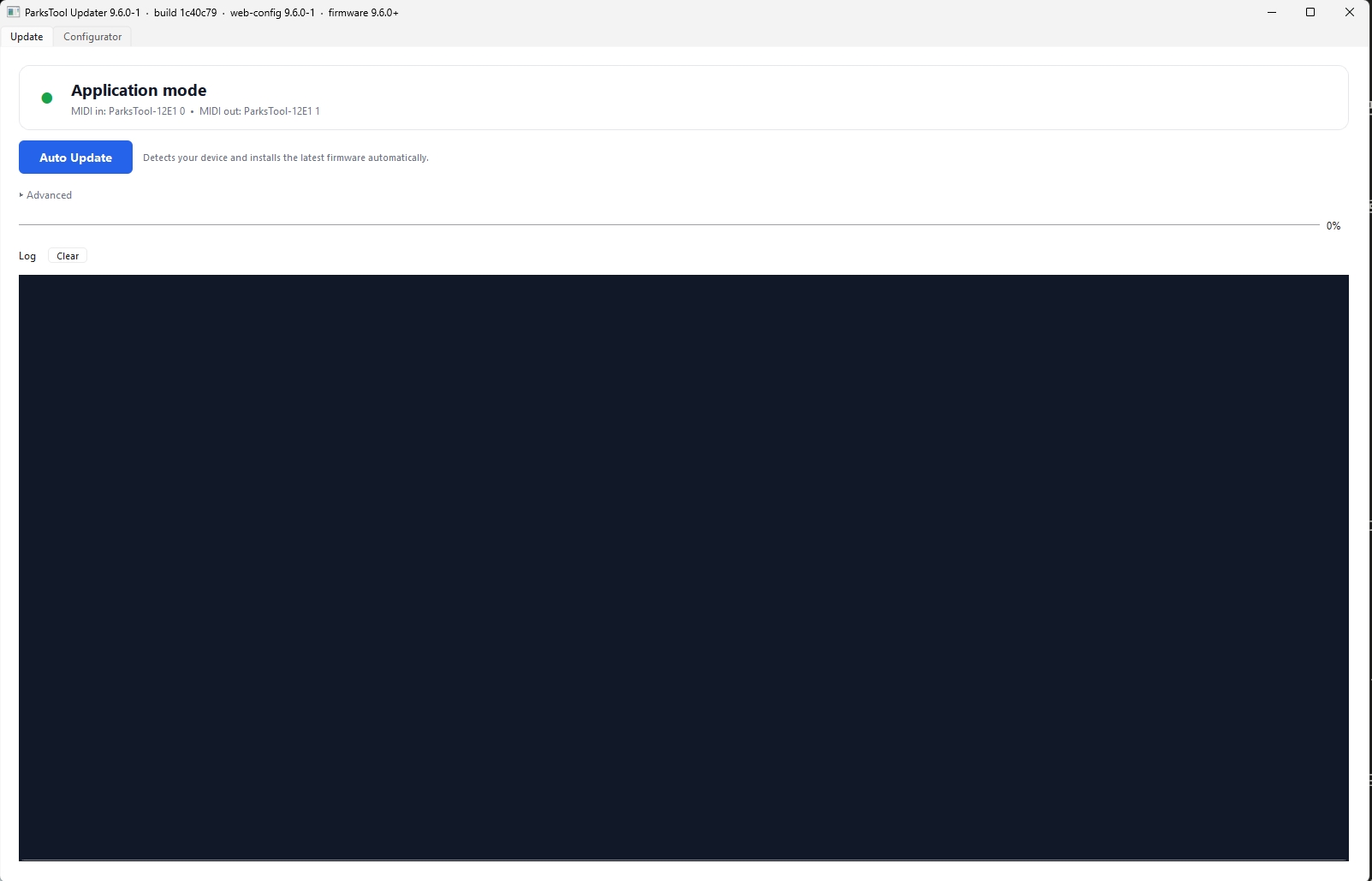
When you connect the USB cable, the device is recognised at the top (green indicator + MIDI in/out names), and pressing the large Auto Update button in the middle installs the latest firmware automatically. Device settings are done in the Configurator tab.
Key features:
Auto-detect + one-click update: Plug in the USB cable and press the
Auto Updatebutton. The tool detects the device, enters upload mode, and burns the firmware in a single pass — no button-holding gymnastics or timing tricks required.Built-in Configurator tab: Configure the device directly inside the tool, no separate browser required. Works offline — the Configurator UI and firmware files are bundled inside the tool itself.
Auto firmware-version matching: The tool reads the device’s current firmware version and shows the matching Configurator UI automatically. 9.5 firmware gets the 9.5 GUI, 9.3 firmware gets the 9.3 GUI. Users on older firmware can still configure safely from a UI that knows their device.
Self-update (coming soon): The tool can pull new versions of itself from GitLab Releases. The feature is ready and will be activated after verification.
Windows / macOS support: Both platforms are supported.
Configuration Reset
New firmware often uses a new memory format, so it may be unusable without performing a reset.
After firmware update, visit the web configuration tool
Reset local defaults
Default Global Reset
Key Features by Firmware Version
Firmware 9.8 — two CCs on one encoder, TRS MIDI THRU
Second CC on 14-BIT CC as well (9.8.1): sending one CC when the encoder is simply turned and another when it is turned while pressed now works in 14-BIT CC too. For 14-bit the CC number can only be chosen from 0 to 31. 14-BIT NRPN is not supported.
The second CC on its own channel (9.8.1): the second CC can be sent on a different MIDI channel from the first, so one knob can address two different instruments.
TRS MIDI THRU priority changed (9.8.1): when there is enough traffic that the two streams have to share the TRS speed, the knobs and keys now give way. A CC from a knob is overwritten by the next value, while a Note Off from a sequencer that is dropped leaves a note sounding.
Two CCs on one encoder (9.8.0): an encoder with a push switch can send one CC when simply turned and a different one when turned while pressed. The two CCs remember their values separately. See Configuration for how to set it up.
TRS MIDI THRU (9.8.0): sends MIDI that the computer sent over USB out of the TRS output as well. It is merged with the device’s own messages, so one TRS cable lets the computer and the controller drive an external instrument together. It is off by default and is switched on in Global Variables. See Advanced Configuration for details.
Warning
9.8.0 is a MINOR version step, which means updating to it clears the settings stored on the device. Before you update, save them with File → Save to File in the web configuration tool, and put them back afterwards with File → Load from File. Going back to an earlier version clears them again.
Firmware 9.7 — LED behaviour improvements (1ES2K)
Automatic LED ring off during sleep (9.7.2): When the PC enters sleep, the encoder’s LED ring turns off automatically and is restored on wake. This works when connected directly via USB-C. For the detailed behaviour and differences by connection type, see “Troubleshooting & FAQ”.
Software LED feedback in Custom mode (9.7.2): In MIDI Custom mode, while the encoder sends rotation-direction values, the LED ring also displays a value bar that follows the CC value sent by software such as a DAW.
LED colour applied immediately (9.7.1): Changing the LED colour of the first Bank now takes effect immediately without a power cycle. (Previously it required re-applying power.)
Firmware 9.6 — Octave-Only Mode
An Octave-Only Mode has been added for the 13-key keyboard product (13K1ES-D24). With this mode on, the encoder shifts the whole keyboard up and down by octaves, so you can play the full MIDI range from just 13 keys. One detent of the encoder corresponds to one octave, and you can also set the octave range (FROM / TO) you can play.
For details on turning it on, setting the octave range, and the encoder behavior, see the Octave-Only Mode section.
Firmware 9.5 — Scene workflow comes together
The 9.5 series builds on the 9.4 Scene v2 model and substantially refines DAW integration and scene operation (latest is 9.5.12). It adds 8 virtual faders inside the device (Virtual Fader), Scene Capture that absorbs values sent by the DAW into a scene, per-bank morph time, a Bank Shift Keys preset, and more.
For detailed usage and examples, see the Scene Workflow — Virtual Fader / Scene Capture (firmware 9.5) section.
Firmware 9.4
Scene model fully redesigned (Breaking Change): The dual LIVE / SCENE bank types and the SCENE_MODE global bit from 9.3.4 are gone, replaced by a single unified model.
Bank = Scene: One bank is one scene. The separate mode toggle is gone.
8 Virtual Faders: See the 9.5 entry above. Channel/CC are common across banks; only values are per-bank.
Broadcast on Bank Change (a checkbox in the BANK FLAGS section): When you change banks, the PEK (Potentiometers, Encoders and Keys) last values and Virtual Fader values for that bank are automatically sent. This gives per-bank fine-grained control over the auto-broadcast behaviour of 9.3.4’s SCENE mode.
EEPROM auto-reset: When you update to 9.4, the bank region of EEPROM is automatically reformatted. You don’t need to run Default Global Reset separately.
Firmware 9.3.5
A brand-new firmware update tool has been built. The previous update tool does not work on firmware later than 9.3.5. Please download the new tool — check the download page in “Firmware Update Process” above for the latest version.
Auto update flow: Connect the USB cable and press the Auto Update button on the tool. Everything after that is automatic — the tool detects the device, enters upload mode, and burns the firmware in a single pass.
Entering upload mode manually: From 9.3.5 to 9.5.12, holding any button while plugging in the USB cable put the device into upload mode. This was removed in 9.5.13 - a key stuck in the pressed state made the device restart over and over. On current firmware, use the RESET button method in Troubleshooting below.
Warning
Never disconnect the USB cable while a firmware update is in progress. If interrupted, the device may stop being recognised over USB. Recovery then requires opening the case and pressing the RESET button on the PCB (see the “Device not recognised over USB” section below).
Firmware 9.3.4
Scene feature added: Banks can be used as LIVE or SCENE type. (Superseded by 9.4 Scene v2.)
Entering a SCENE bank automatically outputs the stored last values (blocks DAW feedback).
A Bank Feature key short-press shifts banks; long-press (2 s) saves all current values to the target bank.
Scene mode can be toggled in the Global Variables panel of the Web Configuration Tool.
Firmware 9.3.3
Broadcast P/E Values Feature Added (Key → SPECIAL Mode, v9.3.3+)
A single key can be assigned to broadcast all current knob/fader values. When pressed, the last known value of every active Potentiometer, Encoder, and Fader is immediately sent as CC messages.
When software is freshly launched or a plugin does not know the current knob positions, a single button press syncs everything — no need to wiggle each knob individually.
In the Web Configuration Tool, set the Key’s Content Type to SPECIAL and Action to Broadcast P/E Values.
Note
Only available for Key (button) types. Values are sent on press only — no action occurs on release.
Firmware 9.3.2
Memory storage issue: If you are using 9.3.0 or 9.3.1, we strongly recommend updating to this version.
A critical bug in the memory section has been discovered that causes errors when saving bank settings. We highly recommend updating to this version to ensure proper functionality of the bank feature.
Firmware 9.3.1
Fixed memory overlap (10th byte) bug during SysEx storage
Firmware 9.3.0
Deej Feature Completely Removed (Breaking Change)
Added SysEx variable substitution feature ({value7bit})
Warning
Deej feature has been removed from all products.
To continue using the Deej feature, you must use firmware version 9.2.x or lower.
Download previous versions: firmware download page
Note
After updating to version 9.3.0, you must perform a configuration reset. The memory structure has changed and is not compatible with previous settings.
The “Enable Deej” checkbox in the Web Configuration Tool no longer functions, and this option will be removed in a future version.
Firmware 9.2.7
Global toggle temporarily turns all keys into toggle keys. For example, a button assigned to Note C0 normally sends a Note On with velocity 127 when pressed and a Note Off when released. When toggle mode is enabled, the key behaves differently: pressing it sends Note On (velocity 127) and releasing it does nothing; the next press then sends the Note Off. That is toggle behavior. The Global toggle feature makes all keys operate this way.
Firmware 9.2.6
Use this feature if you want device keys to remain in a pressed (sustained) state. This feature only applies to controls of the key type.
Firmware 9.2.5
Add more architecture for future products. No effects on any current products
Firmware 9.2.4
Add a small delay on program change logic, minor update
Firmware 9.2.3
Burst message.
Burst mode uses banks. You can send MSB LSB before program change.
Transmission is from higher bank to lower bank order. That is, if you set MSB LSB in Bank2 and set program change in Bank1, MSB LSB is transmitted first.
Firmware 9.2.2
No feature changes
Headroom for Potentiometers/Faders only affected as of 4008 version.
Firmware 9.2.1
13K1ES-D24 octave function support
Octave mode using Bank
Octave Only Mode support
Improved Windows 11 compatibility by removing WMIC dependency
Firmware 9.2.0
13K1ES-D24 octave function support
Octave mode using Bank
Octave Only Mode support
Firmware 9.0.2
Added MIDI input ignore function
Relative control mode support
Value jump prevention function
Firmware 8.0.11
Added last value restore function
60-second delayed save system
Immediate save on Bank change
Firmware 8.0
Major architecture changes
New memory format
Enhanced Bank system
Troubleshooting
Brick recovery (device not recognised over USB)
Most users never run into this. As long as the USB cable stays connected during a firmware update, the update finishes safely.
If USB got disconnected mid-update, or the device is no longer recognised over USB for any reason, you can recover via the RESET button inside the case.
Open the case and find the small RESET button on the board. It is not labelled
RST- a number starting withSWis printed next to it (for exampleSW26on the 8EN16K). It is the only button that is not a key or an encoder.Open the firmware update tool and stay on the Update tab. Close the web configuration tool and any browser tab that has it open - the two share the same port.
Connect the USB cable, open Advanced, and pick your model first by entering the number of knobs, encoders and keys on your device. In upload mode the device cannot report which model it is, so the tool refuses to flash until you pick one.
With the model selected, press the RESET button once. The USB cable must already be connected - do not press it while plugging in and do not hold it down.
The device stays in upload mode for about 8 seconds. Press Auto Update within that time. If you miss it, press RESET again and repeat from step 4.
Note
If the firmware has been erased completely, upload mode stays active with no time limit, so there is no need to hurry. The 8 second limit above applies only while firmware is still on the device.
Note
If it is still not recognised over USB, the upload mode itself is damaged. Recovery in that case requires external programming hardware and is difficult for end users — please contact ParksTool.
Previous Version Displayed in Web Configuration Tool
If the web configuration tool still shows the previous version after firmware update:
Check update completion message
Check version on automatically opened webpage
Clear browser cache and retry
Web Configuration Tool Connection Failure
If unable to connect to web configuration tool after firmware update:
Use Microsoft Edge browser
Close other MIDI applications
Reconnect USB cable
Perform Factory Reset
“Invalid MIDI command” Error
When “Invalid MIDI command: f0 7d 7e f7” error occurs in Chrome:
Use Microsoft Edge browser
Check browser MIDI permission settings
Try in incognito/private mode